

Choosing an office is not simply a matter of comparing monthly rent. The type of workspace you select can affect your cash flow, contractual commitments, ability to grow and the amount of time spent managing premises instead of running your business.
A serviced office provides a furnished, ready-to-use workspace with essential services managed by the operator. A leased office gives your business greater control over its premises, but normally requires a longer commitment, higher initial investment and more responsibility for day-to-day operations.
This guide compares serviced and leased offices in the UK, including costs, contracts, flexibility and what each option involves in practice.
Serviced Office vs Leased Office: The Quick Answer
A serviced office is generally the more practical option when you want to move in quickly, keep initial costs low and retain the flexibility to change your workspace as your business evolves. Furniture, internet, utilities, reception and shared facilities are commonly included within one monthly payment, although the exact package varies between providers.
A leased office may be more suitable when your business has a stable team, a clear long-term plan and the resources to fit out and manage its own premises. It offers greater control over branding, layout and facilities, but usually involves a longer commitment and several costs in addition to the advertised rent.
In simple terms:
- Choose a serviced office if you value flexibility, speed, convenience and predictable costs.
- Consider a leased office if you value control, extensive customisation and long-term occupancy.
- Compare the total cost of occupying each space, not just the headline monthly price.
For startups, small businesses, project teams and growing companies, a serviced office will often provide a lower-risk route into a professional private workspace. For larger, established businesses that expect to remain in the same location for several years, a leased office may become more cost-effective over time.
Serviced Office vs Leased Office at a Glance
| Factor | Serviced office | Leased office |
|---|---|---|
| Workspace | Private, furnished and ready to use | Often unfurnished or requiring fit-out |
| Typical agreement | Usually a flexible licence agreement | Commercial lease |
| Commitment | Often monthly or short term | Usually several years |
| Initial costs | Generally low | Generally high |
| Monthly payment | One fee covering the office and agreed services | Rent plus separate operating costs |
| Furniture | Usually included | Arranged and paid for by the tenant |
| Internet | Usually active and included | Arranged by the tenant |
| Utilities | Commonly included | Normally paid separately |
| Business rates | Commonly incorporated into the package | Normally the tenant’s responsibility |
| Reception | Often included | Arranged by the tenant if required |
| Cleaning | Usually managed by the operator, although coverage varies | Arranged by the tenant |
| Meeting rooms | May be included or available to book | Must form part of the premises or be hired separately |
| Move-in time | Potentially within days | Usually requires more preparation |
| Flexibility | Easier to change office size or leave with notice | Changes depend on the lease |
| Customisation | Usually limited | Greater control over layout and branding |
| Management | Most workspace services are handled by the operator | Tenant manages services and suppliers |
| Exit | Usually governed by a shorter notice period | May involve a break clause, assignment or lease expiry |
| Best suited to | Startups, small teams, growing businesses and projects | Stable businesses with long-term requirements |
These terms describe common workspace models, but they do not determine every legal or financial responsibility. Always check the actual agreement, including what is included, the notice period, VAT, renewal terms and potential exit costs.
What Is a Serviced Office?
A serviced office is a private workspace within a professionally managed building. It is normally furnished, connected and ready to use, allowing a business to move in without organising a complete office fit-out or establishing multiple building services.
Instead of paying rent and then arranging internet, utilities, furniture, reception, maintenance and other essentials separately, the occupier pays the workspace provider a regular fee for the office and an agreed package of services.
The defining feature is not the size of the office. It is the fact that the workspace and its supporting services are managed by an operator.
How Does a Serviced Office Work?
A business selects an available private office based on its team size, preferred location, budget and required facilities. The provider then issues an agreement setting out the term, monthly fee, included services and notice conditions.
Many serviced offices are occupied under a licence agreement rather than a conventional commercial lease. Licence agreements are generally designed to offer shorter commitments and a simpler route into the space. However, the legal structure can vary, so businesses should check the substance of the agreement rather than relying only on its title.
Once the agreement is completed, the occupier can usually move in quickly because the furniture, connectivity and shared facilities are already in place. The provider continues to manage the building, allowing the occupier to focus on operating the business.
What Is Included in a Serviced Office?
The precise package varies between operators, but a serviced office commonly includes:
- A private, furnished office
- Desks, chairs and storage
- Internet connectivity
- Electricity, heating and other utilities
- Reception services
- Building maintenance
- Cleaning of shared areas
- Kitchens and breakout spaces
- Building security
- Mail handling
- Access to meeting rooms
- Business rates within the overall fee
- A professional business address
Some providers also offer business lounges, telephone services, administrative support, networking, mentoring and access to specialist facilities.
It is important to ask whether each service is fully included, subject to a monthly allowance or available for an additional fee.
What Might Cost Extra?
Services that may be charged separately include:
- Additional meeting-room use
- Printing, photocopying and scanning
- Telephone calls
- Dedicated or upgraded internet connections
- Parking
- Electric vehicle charging
- Catering
- Additional furniture
- Office branding
- Storage
- Mail forwarding
- Call answering
- Reception of large or frequent deliveries
Before comparing providers, request a written list of everything included in the monthly price. A lower headline price may not represent better value if the services your business uses regularly are charged separately.
Who Is a Serviced Office Best Suited To?
A serviced office may be particularly suitable for:
- Solo founders who want a professional workspace
- Startups that cannot confidently predict future team size
- Small businesses that want to avoid fit-out costs
- Growing companies that may need more space
- Project teams requiring an office for a limited period
- Established organisations opening satellite offices
- Businesses testing a new location
- Hybrid teams that need a regular private base
- Companies that do not want to manage multiple workspace suppliers

What Is a Leased Office?
A leased office is commercial property occupied under a lease agreed between the tenant and landlord. The tenant secures the right to occupy the premises for a defined period and pays rent according to the terms of the lease.
Unlike a serviced office, the advertised rent for a leased office does not normally represent the complete cost of operating from the property. The tenant may also be responsible for business rates, service charge, utilities, insurance, repairs, cleaning, connectivity, furniture and fit-out.
The level of responsibility depends on the specific lease. Businesses should obtain appropriate professional advice before committing, particularly where the agreement creates long-term repair, reinstatement or financial obligations.
How Does a Commercial Office Lease Work?
A commercial office lease may set out:
- The length of the lease
- The rent and payment schedule
- Rent reviews
- The deposit or guarantee
- Permitted use of the premises
- Repair and maintenance responsibilities
- Service charge obligations
- Insurance arrangements
- Alterations and fit-out permissions
- Break clauses
- Assignment and subletting
- Reinstatement requirements
- Responsibilities at the end of the lease
Commercial leases commonly run for several years, although the term depends on the property and negotiations between the parties.
A break clause may allow the tenant or landlord to end the lease at a specified point, but the right to use it can be subject to strict conditions.
What Does the Tenant Need to Arrange?
Depending on the premises and lease, the tenant may need to arrange and pay for:
- Legal advice
- A commercial property survey
- Office design and fit-out
- Furniture
- Internet installation
- Telephone systems
- Electricity and other utilities
- Business rates
- Service charge
- Insurance
- Cleaning
- Waste collection
- Security and access systems
- Repairs and maintenance
- Health and safety requirements
- Ongoing facilities management
The tenant must also allow enough time for negotiations, legal checks, fit-out and installation before the team can begin using the office.
What Are Dilapidations?
Dilapidations relate to repairs, maintenance or reinstatement that a tenant may be required to complete under the terms of a commercial lease.
At the end of the lease, the landlord may identify work that should have been carried out or alterations that must be reversed. The tenant may need to complete the work or make a financial payment.
Potential dilapidation costs should be considered from the beginning rather than treated as an unexpected expense when the business leaves.
Who Is a Leased Office Best Suited To?
A leased office may be appropriate for:
- An established company with a stable headcount
- A larger team with predictable space requirements
- A business planning to remain in one location for several years
- A company requiring a highly customised layout
- An organisation that wants extensive control over branding
- A business with the capital required for setup
- A company able to manage facilities, contractors and suppliers
Serviced Office vs Leased Office: Key Differences
Contract Length and Commitment
Serviced offices are commonly offered through flexible agreements with shorter minimum terms. Depending on the provider, a business may be able to occupy the space monthly or agree to a longer term in return for more favourable pricing.
A leased office normally requires a commercial lease lasting several years. Although a lease may contain a break clause, the tenant must comply with any conditions attached to it.
Before signing either type of agreement, ask:
- What is the minimum term?
- How much notice is required?
- Does the agreement renew automatically?
- Can the price change at renewal?
- Is there a break clause?
- Can the space be assigned or sublet?
- What happens if the business needs to leave early?
Upfront and Monthly Costs
The upfront cost of a serviced office is normally limited to a deposit, the initial payment and any optional services selected by the occupier. Because the office is furnished and connected, the business may not need to invest in fit-out, furniture or internet installation.
A leased office can require a much larger initial investment, including:
- Rent deposit and rent in advance
- Legal and surveyor fees
- Fit-out and decoration
- Furniture
- Internet and telephone installation
- Security systems
- Moving services
- Utility deposits
The monthly serviced office fee commonly includes several operating costs. The rent on a leased office is normally only one part of the total monthly expense.
Business rates are a tax on most non-domestic properties in England. Businesses considering a lease should check the property through the official business rates service on GOV.UK.
Move-In Time
A serviced office can often be occupied quickly because the principal infrastructure is already in place. Once the agreement is completed, the business may only need to bring laptops and specialist equipment.
Moving into a leased office usually takes longer. The process can include:
- Finding suitable premises
- Negotiating heads of terms
- Completing legal checks
- Conducting a survey
- Agreeing the lease
- Obtaining consent for alterations
- Completing the fit-out
- Installing connectivity
- Purchasing furniture
- Moving the team
Delays can arise if legal negotiations, landlord approvals, contractors or internet installations take longer than expected.
Flexibility to Grow or Downsize
A serviced office provider may be able to move an occupier into a different office within the same building as its requirements change. Availability is not guaranteed, but the model can make it easier to add desks or reduce space at the end of an agreement.
A leased office provides a fixed amount of space for the duration of the lease. If the company grows, the premises may become crowded. If the team becomes smaller or adopts hybrid working, the business may continue paying for unused space.
Leaving a leased office early may require the tenant to:
- Exercise a valid break clause
- Assign the lease
- Sublet some or all of the premises
- Negotiate a surrender
- Continue paying until the lease expires
Control and Customisation
A leased office offers greater control over how the premises look and function. Subject to the lease and landlord consent, the tenant may be able to create a distinctive reception, install meeting rooms and configure the space around specialist requirements.
Customisation in a serviced office is usually more limited. Some operators permit signage or minor layout changes, but significant alterations may not be possible.
A serviced office provides convenience because the workspace has already been prepared. A leased office offers control because the tenant funds and manages the preparation.
Management Responsibilities
The serviced office operator manages the building and coordinates the services covered by the agreement.
In a leased office, the tenant may need to manage:
- Internet and telecommunications
- Utilities
- Cleaning
- Maintenance
- Waste collection
- Security
- Insurance
- Furniture and equipment
- Health and safety
- Contractor access
A larger organisation may have an internal facilities team. In a smaller company, these responsibilities often fall to a founder, director or administrator.
Privacy and Security
Both models can provide a private office. A serviced office is not necessarily coworking. The occupier can have a dedicated, lockable room while sharing reception, kitchens and meeting rooms.
A leased office may give the tenant exclusive control over a larger area. This can help organisations with specialist security or confidentiality requirements.
Before selecting either option, check:
- Who can enter the office and shared areas?
- Is access available outside normal hours?
- How are visitors managed?
- Is CCTV in operation?
- Is secure storage available?
- Are the internet and network arrangements appropriate?
Business Support and Community
Some serviced office providers offer more than physical workspace. Occupiers may have access to networking, mentoring, training and introductions to other businesses.
These benefits can be useful for founders and small teams without a large internal support network.
A leased office does not automatically provide this type of community. The tenant can create its own network and company culture, but must organise those activities independently.
Exit Risks and Responsibilities
Leaving a serviced office is generally straightforward if the occupier follows the notice conditions and returns the space in the required condition.
Leaving a leased office can be more complex. The tenant may be responsible for:
- Rent and charges until the lease ends
- Break clause conditions
- Legal and surveyor fees
- Removing alterations
- Repairing damage
- Reinstating the original layout
- Dilapidations
Understanding how you can leave is as important as understanding how you can move in.
Serviced Office vs Leased Office Costs
A serviced office can appear more expensive when its monthly fee is compared only with the base rent of a leased office. This is not a like-for-like comparison.
The serviced office fee commonly pays for an operational workspace. The rent on a leased office usually pays for the right to occupy the property, with many of the costs required to make it usable charged separately.
Why Headline Rent Does Not Tell the Whole Story
The correct comparison is:
Serviced office total cost = monthly package + deposit-related costs + optional services
Leased office total cost = rent + setup costs + property charges + operating costs + management costs + exit costs
A leased office budget may include:
- Rent
- Deposit
- VAT, where applicable
- Business rates
- Service charge
- Legal fees
- Surveyor fees
- Fit-out
- Furniture
- Internet
- Utilities
- Insurance
- Cleaning
- Security
- Repairs and maintenance
- Facilities management
- Moving costs
- Reinstatement
- Dilapidations
A serviced office may involve additional charges for meeting rooms, printing, telephone usage, parking, catering or dedicated connectivity. Request a complete written quotation based on how your team will actually use the space.
A Practical Example for a Small Team
Consider a five-person business that needs an office for the next 12 months but may recruit additional employees.
With a serviced office, the business could select a furnished room and begin working without purchasing a complete set of furniture or arranging individual building services. Its regular workspace cost would be comparatively easy to identify.
With a leased office, the business might secure a lower base rent but would need to fund and manage the setup. If it left after 12 months, it would have only a short period over which to recover legal, fit-out, furniture and installation costs.
| Consideration | Serviced office | Leased office |
|---|---|---|
| Time before use | Potentially days | Potentially weeks or months |
| Furniture investment | Usually minimal | Usually required |
| Internet | Usually active | Must normally be arranged |
| Number of suppliers | Relatively few | Potentially several |
| Cost predictability | Generally higher | Depends on operating costs |
| Adding employees | May be possible by changing rooms | Depends on available space |
| Leaving after 12 months | Depends on notice period | Depends on lease and exit provisions |
For a small business with uncertain requirements, the value of a serviced office includes time saved, capital preserved and reduced exposure if plans change.
When Can a Leased Office Become More Cost-Effective?
A leased office may become more cost-effective when:
- The business has a larger, stable team
- The space will be occupied for several years
- Headcount is predictable
- Fit-out costs can be spread across a long period
- Extensive customisation is necessary
- The company has facilities-management resources
- The tenant can negotiate favourable terms
There is no universal point at which a leased office becomes cheaper. Compare both options over the same period and test what happens if the team grows, shrinks or needs to leave early.
Advantages and Disadvantages
| Serviced office advantages | Serviced office disadvantages |
|---|---|
| Lower upfront costs | Higher headline monthly price |
| Faster move-in | Limited customisation |
| More predictable costs | Some services may cost extra |
| Flexible agreements | Shared facilities |
| Easier to change office size | Dependence on the operator |
| Less day-to-day management | Less long-term pricing certainty |
| Access to professional facilities | Less control over the building |
| Potential business support and community | Availability may limit expansion |
| Leased office advantages | Leased office disadvantages |
|---|---|
| Greater control over the premises | High initial investment |
| Extensive branding opportunities | Longer commitment |
| Customised layout | More management responsibility |
| Long-term stability | Slower move-in |
| Potential value over a long occupation | Limited flexibility |
| Exclusive use of the premises | Possible exit and dilapidation costs |
Which Office Option Is Right for Your Business?
Choose a Serviced Office If…
A serviced office is likely to be suitable if:
- You need to move in quickly
- You want to avoid a large fit-out investment
- You prefer one regular workspace payment
- Your team size may change
- You need a short or flexible commitment
- You do not have an internal facilities team
- You want furniture and connectivity already arranged
- You need shared meeting rooms and reception
- You are opening a satellite office
- You want to test a location
- You want a professional base without managing an entire property
Consider a Leased Office If…
A leased office may be more appropriate if:
- Your team size is stable
- You expect to remain for several years
- You require extensive customisation
- Your brand needs a fully controlled environment
- You have the capital to fund setup
- You have resources to manage suppliers and facilities
- You require exclusive control over the premises
- The long-term financial comparison supports leasing
Questions to Ask Before Deciding
- How many people need a regular workspace?
- How might the team change over the next 12 to 36 months?
- How many employees will use the office simultaneously?
- How long will the company realistically remain?
- How quickly must the office become operational?
- How much capital is available for the move?
- Does the business need a customised layout?
- Who will manage the premises and suppliers?
- How often will the team use meeting rooms?
- Is 24-hour access required?
- Will clients visit regularly?
- What happens if the business needs to leave early?
- What is the total cost over the expected occupation period?
What Should You Check Before Choosing a Serviced Office?
Not all serviced offices provide the same services, agreement terms or working experience.
Contract and Pricing
Ask the provider to confirm:
- The minimum term
- The required notice
- The deposit
- The complete monthly price
- Whether VAT applies
- Which services are included
- Which services have usage limits
- Additional meeting-room costs
- Printing and telephone charges
- Parking costs
- Renewal terms
- How long the quoted price is fixed
- Conditions for moving to another office
- Charges that apply when leaving
The words “all-inclusive” should be supported by a written list.
Workspace, Connectivity and Facilities
During the viewing, check:
- The number of desks that fit comfortably
- Natural light
- Heating and air conditioning
- Noise and privacy
- Secure storage
- Power sockets
- Wi-Fi coverage
- Wired network points
- Internet speed
- Mobile reception
- Space for future employees
- Access hours
- Reception hours
- Meeting rooms
- Kitchens and breakout areas
- Showers and changing facilities
- Bicycle storage
- Parking
- Lift and step-free access
- Security arrangements
If employees will work early, late or at weekends, confirm that the office itself is accessible during those periods.
Business Services
Ask whether the provider offers:
- Reception and visitor management
- Mail handling
- Company registration
- Call answering
- Meeting-room booking
- Catering
- Networking
- Mentoring
- Business training
- Creative or production facilities
The quality of the people managing the building can be as important as the furniture, location and price.

A Serviced Office in Practice: UP at Weatherill House
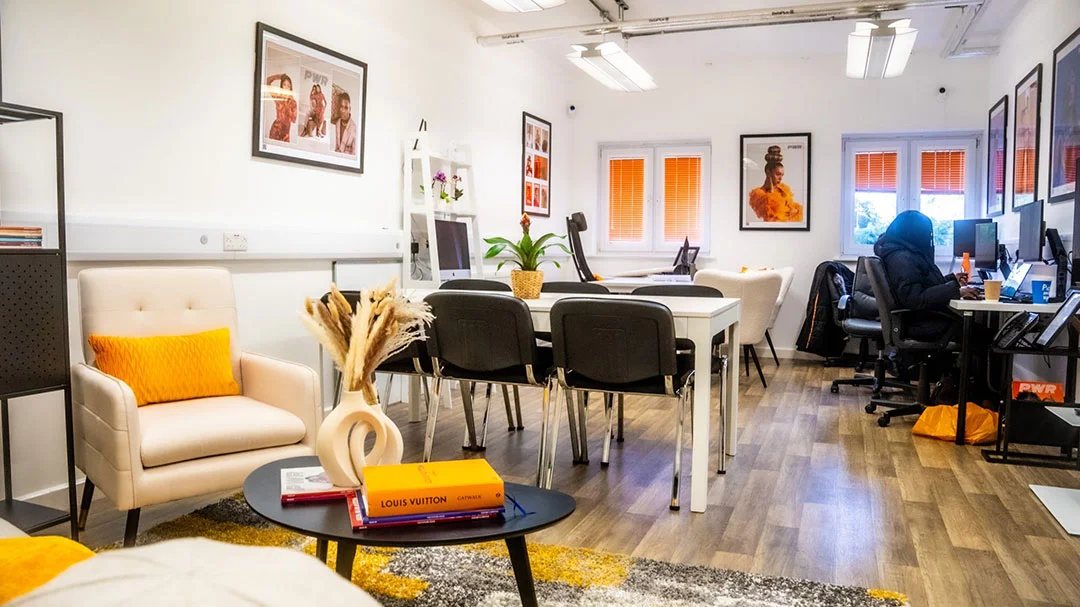
UP provides furnished private offices at Weatherill House Business Centre in Croydon for solo founders and teams of up to eight people. The offices are ready to use and available with a minimum term of one month.
What Is Included at UP?
Serviced offices at UP include:
- A private, fully furnished office
- Desks, chairs and storage
- Superfast Wi-Fi
- Cat6 wired network points
- Unlimited broadband with speeds of up to 800 Mbps for upload and download
- Individually controlled air conditioning
- A dedicated VoIP telephone, with the first handset and line included
- Managed reception services
- Access to the Business Lounge
- Five hours of meeting-room use each month
- Mail handling and company registration support
- Kitchens on every floor
- Secure bicycle storage
- CCTV inside and outside the building
- Lift access to every floor
- Showers and changing facilities
- Secure access 24 hours a day
- Access to printing, photocopying and scanning facilities
- Business support services
- A 20% discount on access to the UP CREATIVE
Some facilities may be subject to availability, usage limits or additional charges. These include parking, electric vehicle charging, additional meeting-room hours, printing and telephone usage.
Flexibility for Small and Growing Teams
UP offers private offices in several sizes:
- One to three desks
- Four to five desks
- Six to eight desks
The minimum term is one month, and occupiers can opt in or opt out with one month’s notice, subject to the agreement.
If a team’s requirements change, UP can explore other available office options within Weatherill House. Any move depends on availability, but the range of office sizes creates a practical route for growth.
More Than a Physical Office
A serviced office at UP is part of a wider business ecosystem. Occupiers can access opportunities and services relating to:
- Business mentoring
- Training and business support
- Networking
- Meeting and event space
- Content production
- Podcasting and video
- Virtual office services
- Connections with local businesses
Why Consider Croydon?
Weatherill House is situated at New South Quarter, 23 Whitestone Way, Croydon, CR0 4WF.
The location offers:
- Wandle Park tram stop within walking distance
- Connections to East Croydon Station
- Train journeys from East Croydon to Central London in approximately 16 minutes
- Bus and tram connections across Croydon
- Shops, food and local services nearby
- Access to Purley Way
- Parking options near the building
- Electric vehicle charging options, subject to availability
- A professional South London business address
Explore serviced offices at UP in Croydon
Final Verdict: Serviced Office or Leased Office?
Neither option is right for every business.
A serviced office is likely to be the stronger choice when the business values a quick move, low initial investment, flexible terms, predictable costs and fewer management responsibilities.
A leased office may be preferable when the business has a stable team, a long-term property strategy and the resources to manage and customise its own premises.
The decision ultimately depends on certainty. If your team size, working pattern or location requirements may change, flexibility has significant value. If your requirements are predictable for several years, a lease may provide the control your company needs.
Before deciding, compare both options over the same period. Include setup, operation, management and exit costs, not just the advertised rent.
For many founders, small businesses and growing teams, a serviced office provides a practical balance of privacy, professional facilities and flexibility.
Looking for a Serviced Office in Croydon?
UP offers furnished private offices for individuals and teams of up to eight people at Weatherill House Business Centre.
With flexible terms, 24-hour access, fast internet, reception services and shared business facilities, you can move into a professional workspace without organising a complete office setup.
Book a viewing at UP Weatherill House
Frequently Asked Questions
What Is the Main Difference Between a Serviced Office and a Leased Office?
A serviced office is furnished, connected and managed by a workspace provider. The occupier normally pays one monthly fee for the office and an agreed package of services.
With a leased office, the tenant gains more control but is usually responsible for fit-out, furniture, utilities, business rates, maintenance and other operating costs.
Is a Serviced Office Cheaper Than a Leased Office?
For short-term occupancy or a small team, a serviced office can be more cost-effective once fit-out, furniture, business rates, utilities, professional fees and management time are considered.
A leased office may become more cost-effective for a larger, stable team occupying the premises for several years.
What Is Included in a Serviced Office?
A serviced office commonly includes a furnished private office, internet, utilities, reception, building maintenance, security and shared facilities.
The exact package varies. Parking, printing, telephone usage and additional meeting-room hours may cost extra.
Are Utilities and Business Rates Included?
Utilities and business rates are commonly incorporated into serviced office fees, but businesses should confirm this in writing with the provider.
In a leased office, these costs are normally separate from the rent.
Is a Serviced Office Private?
A serviced office can provide a private, lockable room used only by your business. Reception, kitchens, meeting rooms and breakout areas are normally shared.
This differs from coworking, where individuals usually work at desks within a shared open workspace.
How Long Is a Serviced Office Agreement?
Agreements can range from monthly arrangements to terms of one year or longer. Providers may offer a lower monthly price in exchange for a longer commitment.
UP offers serviced offices with a minimum term of one month and one month’s notice, subject to the agreement.
Can I Register My Company at a Serviced Office?
Many providers allow occupiers to use the address for company registration, but this should be confirmed before signing.
UP provides mail handling and company registration support as part of its serviced office offering.
Can a Serviced Office Accommodate a Growing Team?
A provider may be able to offer a larger office within the same building when a business grows. This depends on availability and the terms of the agreement.
UP offers private offices designed for teams ranging from one to eight people.
Are Meeting Rooms Included?
Some providers include a monthly allowance, while others charge for every booking.
UP includes five hours of meeting-room use each month. Additional meeting-room hire is available when more time is required.
How Quickly Can I Move Into a Serviced Office?
A serviced office can often be occupied within days because the furniture, internet and essential services are already in place.
The actual timescale depends on availability, required checks, payment and completion of the agreement.
When Does a Leased Office Become More Cost-Effective?
A leased office may become more cost-effective when a business has a larger, stable team and expects to occupy the same space for several years.
The calculation should include rent, business rates, service charge, fit-out, furniture, utilities, insurance, maintenance, management and exit costs.
What Should I Ask During a Viewing?
Ask:
- What is included in the monthly price?
- Which services cost extra?
- What is the minimum term?
- What notice is required?
- Does VAT apply?
- How fast and reliable is the internet?
- How many meeting-room hours are included?
- Is access available 24 hours a day?
- Can the company use the address for registration?
- What happens if the team grows?
- How is the building secured?
- How long is the quoted price fixed?
- What charges apply when leaving?
Visit during normal working hours, check noise levels, test mobile reception and confirm that the team can work comfortably within the available space.
Serviced Office vs Leased Office: Key Differences
The practical difference between a serviced office and a leased office is the amount of commitment, investment and management responsibility your business is prepared to accept.
A serviced office allows you to pay for a ready-to-use workspace and supporting services through one provider. A leased office gives you greater control over the premises, but your business normally assumes more responsibility for setting up, operating and eventually leaving the space.
Contract Length and Commitment
Serviced offices are commonly offered through flexible agreements with shorter minimum terms. Depending on the provider, a business may be able to occupy the space monthly or agree to a longer period in return for more favourable pricing.
A leased office normally requires a commercial lease lasting several years. Although a lease may contain a break clause, the tenant must meet the conditions attached to it. Missing a deadline or failing to comply with a condition could prevent the business from ending the lease at the intended point.
The main questions to ask are:
- What is the minimum term?
- How much notice is required?
- Does the agreement renew automatically?
- Can the price change when the agreement is renewed?
- Is there a break clause?
- What conditions apply to the break clause?
- Can the space be assigned or sublet?
- What happens if the business needs to leave early?
A shorter agreement can be valuable when headcount, revenue or working patterns remain uncertain. A longer lease may be reasonable when a business has predictable requirements and is confident that the space will remain suitable.
Upfront Costs
The upfront cost of a serviced office is normally limited to a deposit, the initial monthly payment and any optional services selected by the occupier. Because the office is already furnished and connected, the business may not need to invest in fit-out, furniture or internet installation.
A leased office can require a much larger initial investment. Before the team begins working from the premises, the business may need to pay for:
- A rent deposit
- Rent in advance
- Legal advice
- Surveyor fees
- Fit-out and decoration
- Furniture
- Internet installation
- Telephone systems
- Security and access systems
- Moving services
- Deposits for utilities
- Professional and regulatory assessments
These costs can place pressure on cash flow, particularly for a new or growing business. Money committed to premises is then unavailable for recruitment, marketing, equipment, product development or working capital.
Monthly Costs
A serviced office usually combines the office and an agreed package of services into one monthly payment. This can make budgeting simpler because the business receives fewer separate invoices and has fewer suppliers to manage.
Depending on the provider, the fee may include:
- Occupation of the private office
- Furniture
- Internet
- Utilities
- Business rates
- Reception
- Building maintenance
- Security
- Cleaning
- Shared facilities
- An allowance for meeting rooms
A leased office separates the rent from many of the costs required to operate the premises. In addition to rent, the tenant may need to budget for:
- Business rates
- Service charge
- Electricity, water and heating
- Internet and telephone services
- Insurance
- Cleaning
- Repairs and maintenance
- Waste collection
- Security
- Facilities management
- Equipment replacement
Business rates are a tax on most non-domestic properties in England. The amount depends on the property’s rateable value and the applicable multiplier, subject to any relief for which the occupier qualifies. Businesses considering a lease should check the property through the official business rates service on GOV.UK.
Move-In Time
A serviced office can often be occupied quickly because the principal infrastructure is already in place. Once the agreement has been completed, the business may only need to bring laptops, files and any specialist equipment.
Moving into a leased office usually takes longer. The process may include:
- Finding suitable premises
- Negotiating heads of terms
- Completing legal checks
- Conducting a survey
- Agreeing the lease
- Obtaining consent for alterations
- Designing and completing the fit-out
- Installing internet and telephone services
- Purchasing furniture
- Moving the team into the premises
Delays can arise if legal negotiations, landlord approvals, contractors or internet installations take longer than expected. Businesses should consider the financial effect of this waiting period, particularly if they must pay for temporary space or overlap between locations.
Flexibility to Grow or Downsize
A serviced office provider may be able to move an occupier into a different office within the same building as its requirements change. Availability is not guaranteed, but this model can make it easier to add desks, accommodate new employees or reduce the amount of space at the end of an agreement.
A leased office provides a fixed amount of space for the duration of the lease. If the company grows faster than expected, the premises may become crowded. If the team becomes smaller or adopts hybrid working, the business may continue paying for space it no longer needs.
Leaving or changing a leased office before the end of the term may require the tenant to:
- Exercise a valid break clause
- Assign the lease to another business
- Sublet some or all of the premises
- Negotiate a surrender with the landlord
- Continue paying until the lease expires
Each option depends on the lease and may involve professional fees, landlord approval or additional conditions.
Control and Customisation
A leased office offers greater control over how the premises look and function. Subject to the lease and any necessary landlord consent, the tenant may be able to create a distinctive reception area, install meeting rooms, display extensive branding and configure the space around specialist operational requirements.
Customisation in a serviced office is usually more limited. The provider selects the general furniture, finishes and shared facilities. Some operators permit signage, branded materials or changes to the layout, but significant alterations may not be possible.
This creates a clear trade-off. A serviced office provides convenience because the decisions have already been made. A leased office offers control because the tenant assumes responsibility for making and funding those decisions.
Management Responsibilities
The serviced office operator manages the building and coordinates the services covered by the agreement. If a shared facility requires attention, the occupier normally reports it to the on-site team rather than finding a contractor independently.
In a leased office, the tenant may need to manage several suppliers and responsibilities, including:
- Internet and telecommunications
- Utilities
- Cleaning
- Maintenance
- Waste collection
- Security
- Health and safety
- Furniture and equipment
- Contractor access
- Insurance
- Compliance with the lease
A larger organisation may have an internal facilities team to handle these responsibilities. In a smaller company, they often fall to a founder, director or administrator whose time could otherwise be spent on the business.
Privacy and Security
Both models can provide a private office. A serviced office is not necessarily the same as coworking. The occupier can have a dedicated, lockable room while sharing reception, kitchens, meeting rooms and other common facilities.
A leased office may give the tenant exclusive control over a larger part of the premises. This can be helpful for organisations with specialist security, confidentiality or access requirements.
Before selecting either option, a business should check:
- Who can enter the office and shared areas?
- Is access available outside normal working hours?
- How are visitors managed?
- Is CCTV in operation?
- How are keys, cards or electronic fobs controlled?
- Can confidential conversations be overheard?
- Is there secure storage?
- What happens when an employee leaves?
- Are the internet and network arrangements suitable for the business?
Businesses handling sensitive information should also carry out their own information security and data protection assessment. A serviced office provider’s physical security does not replace the occupier’s responsibility for its devices, systems and data.
Business Support and Community
Some serviced office providers offer more than physical workspace. Occupiers may have access to reception services, networking events, mentoring, training and introductions to other businesses.
These benefits can be particularly useful for founders and small teams that do not have a large internal support network. A well-managed business centre can provide opportunities to meet clients, suppliers, mentors and potential collaborators.
A leased office does not automatically provide this type of community or support. The tenant can create its own company culture and professional network, but must organise those activities independently.
The value of community varies between businesses. Some teams want regular interaction and support, while others prioritise privacy and independence. During a viewing, ask what support is genuinely available and how frequently occupiers use it.
Exit Risks and Responsibilities
Leaving a serviced office is generally straightforward if the occupier follows the notice conditions and returns the space in the required condition. The agreement should still be checked for renewal terms, notice deadlines, damage charges and any services that must be cancelled separately.
Leaving a leased office can be more complex. The tenant may be responsible for:
- Rent and other charges until the lease ends
- Compliance with break clause conditions
- Legal and surveyor fees
- Removing alterations
- Repairing damage
- Reinstating the original layout
- Clearing the premises
- Dilapidations
- Finding an assignee or subtenant
The ability to enter a space is only half of the decision. A business should understand how it can leave before signing any agreement.
Serviced Office vs Leased Office Costs
A serviced office can appear more expensive when its monthly fee is compared only with the base rent of a leased office. This is not a like-for-like comparison.
The serviced office fee commonly pays for an operational workspace. The rent on a leased office usually pays for the right to occupy the property, with many of the costs required to make it usable charged or arranged separately.
A more reliable comparison considers the total cost of occupancy over the period in which the business expects to use the space.
Why Headline Rent Does Not Tell the Whole Story
Suppose a business compares a serviced office costing a single monthly amount with a leased office advertised at a lower monthly rent. The leased office may initially appear cheaper, but the business still needs to establish:
- Whether business rates are payable
- How much the service charge will be
- What utilities are likely to cost
- Whether the premises require fit-out
- How much furniture is needed
- How long internet installation will take
- Who will arrange cleaning and maintenance
- What insurance is required
- Whether VAT applies
- What professional fees will be incurred
- What the exit obligations could cost
The serviced office also needs careful examination. An “all-inclusive” description does not necessarily mean that every possible service is free. Meeting rooms, parking, printing, telephone calls and other facilities may be limited or charged according to use.
The correct comparison is therefore:
Serviced office total cost = monthly package + deposit-related costs + optional services
Leased office total cost = rent + setup costs + property charges + operating costs + management costs + exit costs
Typical Serviced Office Costs
A serviced office budget may include:
- Monthly office fee
- Deposit
- VAT, where applicable
- Additional meeting-room use
- Printing and copying
- Telephone usage
- Parking
- Electric vehicle charging
- Catering
- Additional storage
- Optional business services
- Costs for damage beyond reasonable use
The most important step is to request a complete written quotation based on how the team will actually use the space.
Typical Leased Office Costs
A leased office budget may include:
- Rent
- Rent deposit
- VAT, where applicable
- Business rates
- Service charge
- Legal fees
- Surveyor fees
- Fit-out
- Furniture
- Internet installation and monthly service
- Telephone systems
- Utilities
- Insurance
- Cleaning
- Security
- Repairs and maintenance
- Waste collection
- Facilities management
- Moving costs
- Reinstatement
- Dilapidations
Some costs are paid at the beginning, some arise monthly or quarterly, and others may only become visible at the end of the lease. All of them should be considered when comparing the options.
A Practical Cost Example for a Small Team
Consider a five-person business that needs an office for the next 12 months but may recruit additional employees during that period.
With a serviced office, the business could select a furnished room, complete a short agreement and begin working without purchasing a complete set of furniture or arranging individual building services. Its regular workspace cost would be comparatively easy to identify, although it would still need to account for any optional usage charges.
With a leased office, the business might secure a lower base rent but would need to fund and manage the setup. If the company left after only 12 months, it would have a relatively short period over which to recover the cost of legal work, fit-out, furniture and installations. It could also remain responsible for the lease beyond the period for which it actually needed the space.
The practical comparison would look like this:
| Consideration | Serviced office | Leased office |
|---|---|---|
| Time required before use | Potentially days | Potentially weeks or months |
| Furniture investment | Usually minimal | Usually required |
| Internet installation | Usually already active | Must normally be arranged |
| Number of suppliers | Relatively few | Potentially several |
| Cost predictability | Generally higher | Depends on operating and property costs |
| Adding another employee | May be possible by changing rooms or adding a desk | Depends on available space |
| Leaving after 12 months | Depends on the agreed notice period | Depends on lease length and exit provisions |
| Recovery of setup costs | Little setup investment to recover | Setup costs must be spread across the occupancy period |
For a small business with uncertain requirements, the value of the serviced office is not limited to the room. It also includes time saved, capital preserved and reduced exposure if plans change.
When Does a Leased Office Become More Cost-Effective?
A leased office may become more cost-effective when:
- The business has a larger, stable team
- The space will be occupied for several years
- Headcount is reasonably predictable
- The business can spread fit-out costs over a long period
- Extensive branding or customisation is necessary
- The company has internal facilities-management resources
- The tenant can negotiate favourable lease terms
- The premises will remain suitable throughout the commitment
There is no universal point at which a leased office becomes cheaper. The answer depends on location, property size, lease terms, fit-out requirements, service charge, business rates and the length of occupation.
The safest approach is to calculate the expected cost of both options over the same period and then test what happens if the team grows, shrinks or needs to leave earlier than planned.
Advantages and Disadvantages of a Serviced Office
A serviced office removes many of the practical and financial barriers involved in establishing a workplace. However, its suitability depends on how much your business values flexibility and convenience compared with control and customisation.
Advantages of a Serviced Office
Lower Upfront Costs
Because the office is already furnished, connected and operational, a business can avoid many of the initial costs associated with fitting out leased premises.
The business may not need to purchase desks and chairs, install internet infrastructure or establish separate contracts for every building service. This preserves capital for other priorities, such as recruitment, marketing, equipment and business development.
Faster Move-In
A serviced office can often be occupied shortly after the agreement is completed. Furniture, internet and shared facilities are already in place, reducing the time between selecting an office and beginning work.
This can be particularly valuable when a business needs to:
- Leave its current premises quickly
- Begin a new project
- Recruit employees
- Open a satellite office
- Move out of a home-based workspace
- Establish a professional presence in a new location
More Predictable Monthly Costs
A serviced office commonly combines the workspace and an agreed package of services into one monthly payment. This reduces the number of separate bills the business must forecast and manage.
The exact package should always be confirmed, but it may include furniture, internet, utilities, business rates, reception, maintenance, security and shared facilities.
Flexible Agreements
Serviced office agreements are generally shorter than commercial leases. This can reduce the risk of paying for unsuitable space if the business changes direction, adopts a different working pattern or experiences unexpected growth.
Flexibility can also make it easier to test a new location before making a longer commitment.
Easier to Grow or Downsize
Where suitable offices are available within the same business centre, an occupier may be able to move to a different room as its team changes.
This allows the workspace to follow the development of the business rather than requiring the business to predict its exact space requirements several years in advance.
Less Day-to-Day Management
The operator manages the building and coordinates many of the services required to keep it functioning. The occupier does not normally need to find separate suppliers for every repair or facilities issue.
This can save considerable time for a small team without a dedicated facilities manager.
Professional Facilities
Serviced offices can provide facilities that would be expensive for a small business to establish independently, such as:
- A managed reception
- Business lounges
- Meeting rooms
- Kitchens
- Breakout areas
- Security systems
- Showers and changing facilities
- Bicycle storage
- Printing and scanning facilities
Because these facilities are shared, smaller businesses can access them without paying the full cost of creating and maintaining them.
Professional Business Presence
A serviced office gives a business a physical location where it can work, receive visitors and hold meetings. Depending on the provider and agreement, it may also offer a business address, mail handling and company registration support.
This can create a more professional experience for clients, employees and partners than working exclusively from a residential address.
Business Support and Community
Some serviced office operators provide networking, mentoring, events and practical business support. Occupiers may also benefit from being located alongside other founders and companies.
The value of these opportunities depends on the provider and the level of participation, but a strong business community can create useful relationships, referrals and collaborations.
Disadvantages of a Serviced Office
Higher Headline Monthly Price
The monthly fee for a serviced office may appear higher than the advertised rent for a leased office. This is partly because the serviced office price commonly includes furniture, services and shared facilities.
The comparison should therefore consider total occupancy costs. However, a business that remains in the same location for many years may find that the convenience premium becomes less economical over time.
Limited Customisation
The operator controls the general design, furniture and shared areas. Occupiers may be permitted to display branding or make minor changes, but significant alterations are often restricted.
A business requiring a specialist layout or fully branded environment may find a leased office more suitable.
Potential Additional Charges
Not every service is necessarily included without limit. A serviced office provider may charge separately for:
- Additional meeting-room hours
- Printing
- Telephone calls
- Parking
- Catering
- Dedicated internet
- Storage
- Additional furniture
- Mail forwarding
The occupier should ask for a complete schedule of charges before signing.
Shared Facilities
Although the office itself may be private, kitchens, reception areas, lifts, meeting rooms and other facilities are commonly shared.
This can create occasional limitations relating to availability, noise or privacy. Businesses should view the space during normal working hours to understand how busy the shared areas become.
Dependence on the Operator
The experience of occupying a serviced office depends heavily on the quality of the operator. Internet reliability, building maintenance, reception standards and responsiveness can all affect the working environment.
Businesses should review the agreement, visit the building and speak to the team responsible for managing it.
Less Control Over Price Changes
A flexible agreement can make leaving easier, but it may also provide less long-term certainty over pricing. The monthly fee could change at renewal or when the business moves to a different office.
The occupier should ask:
- How long is the quoted price fixed?
- What happens at renewal?
- How much notice is given before an increase?
- Is a longer fixed term available?
- Are additional services subject to separate price changes?
Advantages and Disadvantages of a Leased Office
A leased office provides greater control and permanence, but it also transfers more financial and operational responsibility to the tenant.
Advantages of a Leased Office
Greater Control Over the Space
Subject to the lease and landlord approval, a tenant can design the workspace around its own requirements. This may include:
- Creating private offices
- Installing meeting rooms
- Changing the floor layout
- Selecting furniture and finishes
- Adding specialist equipment
- Establishing dedicated reception facilities
- Configuring security and access systems
This level of control can be important for a company with specialist operational or confidentiality requirements.
Stronger Branding Opportunities
A leased office can be designed to reflect the company’s brand, culture and client experience. The tenant may have greater freedom over signage, colours, furniture and the overall presentation of the premises.
This can be valuable for businesses that regularly host clients or use the office as part of recruitment and brand positioning.
Long-Term Stability
A commercial lease can give a business certainty that it has the right to occupy the premises for an agreed period, provided it complies with the lease.
For a stable company that intends to remain in the same location, this can provide continuity for employees, clients and operations.
Potential Long-Term Value
Although the initial investment can be substantial, a leased office may become more cost-effective when occupied by a stable team over a sufficiently long period.
The tenant has more opportunity to spread fit-out and setup costs across several years. Whether this produces a saving depends on the rent, business rates, service charge, operating expenses and responsibilities under the lease.
Exclusive Use of the Premises
Depending on the property, a leased office may give the business exclusive control over the entire space rather than a private room within a managed centre.
This can provide greater privacy and control over access, facilities and working conditions.
Disadvantages of a Leased Office
High Initial Investment
A leased office may require considerable spending before the team can move in. Legal advice, surveys, fit-out, furniture, connectivity and deposits can create a significant cash requirement.
These costs are particularly important when the business has not yet established how long it will remain or how quickly its team may change.
Longer Commitment
Commercial leases commonly involve a commitment of several years. If the business no longer needs the space, it may remain liable for rent and other charges unless it can use a break clause, assign the lease, sublet the property or negotiate a surrender.
Greater Management Responsibility
The tenant may need to coordinate several services and suppliers. Depending on the lease, this can include:
- Utilities
- Internet
- Cleaning
- Maintenance
- Security
- Insurance
- Waste collection
- Repairs
- Health and safety
- Facilities management
For a small company, these responsibilities can consume time that would otherwise be spent on customers and growth.
Slower Move-In
Legal negotiations, landlord approvals, fit-out work and internet installation can delay occupation. The business may also need temporary workspace while the leased premises are prepared.
Limited Flexibility
The amount of space remains fixed even if the team changes. Growth may make the office too small, while remote or hybrid working may leave the company paying for unused space.
Exit and Dilapidation Costs
At the end of the lease, the tenant may need to repair the premises, remove alterations and return the space in the condition required by the agreement.
These obligations can create a substantial cost if they were not considered and managed throughout the lease.
Which Office Option Is Right for Your Business?
The right choice depends on the stage of the business, the certainty of its plans and the resources available to manage the premises.
A useful starting point is to ask how confidently the company can predict its requirements for the next few years. The less certain the answer, the more valuable flexibility may become.
Choose a Serviced Office If…
A serviced office is likely to be suitable if:
- You need to move in quickly
- You want to avoid a large fit-out investment
- You prefer one regular workspace payment
- Your team size may change
- You need a short or flexible commitment
- You do not have an internal facilities team
- You want furniture, internet and utilities already arranged
- You need access to shared meeting rooms and reception
- You are opening a new branch or satellite office
- You want to test a location before making a longer commitment
- You want a professional base without managing an entire property
A serviced office can be especially useful when flexibility protects the business from uncertainty. Paying for convenience may be worthwhile if it avoids tying up capital or entering a lease that could become unsuitable.
Consider a Leased Office If…
A leased office may be more appropriate if:
- Your team size is stable and predictable
- You expect to remain in the same location for several years
- You require extensive customisation
- Your brand needs a distinctive, fully controlled environment
- You have the capital to fund fit-out and setup
- You have the resources to manage suppliers and facilities
- You require exclusive control over the premises
- You can accept the responsibilities and risks of a commercial lease
- The long-term financial comparison supports leasing
The lower advertised rent of a leased office should not be the only reason for selecting it. The business must also be able to absorb the setup costs, operational responsibilities and reduced flexibility.
Questions to Ask Before Deciding
Before comparing individual properties, answer the following questions:
- How many people need a regular workspace today?
- How might the team change over the next 12, 24 and 36 months?
- How many employees will use the office at the same time?
- Does the business expect to adopt or expand hybrid working?
- How long does the company realistically expect to remain?
- How quickly does the office need to be operational?
- How much capital is available for the move?
- Does the business need a highly customised layout?
- How important is visible branding?
- Who will manage the premises and suppliers?
- How often will the team use meeting rooms?
- Is 24-hour access required?
- Does the business need parking or bicycle storage?
- Will clients visit regularly?
- What happens if the business needs to leave earlier than expected?
- What is the total cost over the expected occupation period?
The answers should be used to create a list of essential requirements before viewings begin.
What Should You Check Before Choosing a Serviced Office?
Not all serviced offices provide the same services, agreement terms or working experience. A careful viewing and a detailed written quotation can prevent unexpected costs later.
Contract and Pricing
Ask the provider to confirm:
- The minimum agreement term
- The required notice period
- The deposit
- The complete monthly price
- Whether VAT applies
- Which services are included
- Which services are subject to an allowance
- The price of additional meeting-room use
- Printing and telephone charges
- Parking costs
- Renewal terms
- How long the quoted price is fixed
- Conditions for moving to a larger or smaller office
- Charges that may apply when leaving
The words “all-inclusive” should be supported by a clear written list. If a service is important to the business, do not assume it is included.
Workspace and Connectivity
During the viewing, check:
- The number of desks that fit comfortably
- Natural light
- Heating and air conditioning
- Noise from neighbouring offices and shared areas
- Privacy for telephone and video calls
- Secure storage
- Power sockets
- Wi-Fi coverage
- Wired network points
- Internet speed
- Options for dedicated connectivity
- Mobile phone reception
- Space for future employees
Ask whether the advertised internet speed applies across the building and whether the connection is shared, dedicated or subject to a usage policy.
Facilities and Access
Confirm what the team can access and when:
- Building opening hours
- Secure access outside staffed hours
- Reception hours
- Meeting rooms
- Business lounges
- Kitchens
- Breakout areas
- Toilets
- Showers and changing facilities
- Bicycle storage
- Parking
- Electric vehicle charging
- Lifts and step-free access
- Emergency procedures
- CCTV and other security measures
If employees will work early, late or at weekends, make sure the office itself, and not only the building entrance, is available during those periods.
Business Services
Ask what support is available beyond the physical office:
- Reception and visitor management
- Mail handling
- Receipt of letters and parcels
- Company registration
- Call answering
- Telephone services
- Administrative support
- Meeting-room booking
- Catering
- Networking events
- Mentoring
- Business training
- Introductions to other organisations
- Creative or production facilities
It is also useful to understand who manages the centre and how quickly the team responds when an issue is reported.
A serviced office should reduce friction for the occupier. The quality of the people managing the building can therefore be as important as the furniture, location and monthly price.
A Serviced Office in Practice: UP at Weatherill House
Understanding the theory is useful, but examining a real serviced office package makes the differences easier to see.
UP provides furnished private offices at Weatherill House Business Centre in Croydon for solo founders and teams of up to eight people. The offices are ready to use and available with a minimum term of one month.
Instead of arranging the workspace, connectivity and building services independently, an occupier receives an office and a range of supporting services through one provider.
What Is Included at UP?
Serviced offices at UP include:
- A private, fully furnished office
- Desks, chairs and storage
- Superfast Wi-Fi
- Cat6 wired network points
- Unlimited broadband with speeds of up to 800 Mbps for upload and download
- Individually controlled air conditioning
- A dedicated VoIP telephone, with the first handset and line included
- Managed reception services
- Access to the Business Lounge
- Five hours of meeting-room use each month
- Mail handling
- Company registration support
- Kitchens on every floor
- Secure bicycle storage
- CCTV surveillance inside and outside the building
- Lift access to every floor
- Showers and changing facilities
- Secure access 24 hours a day
- Access to printing, photocopying and scanning facilities
- Business support services
- A 20% discount on access to the UP CREATIVE
Some services and facilities may be subject to availability, usage limits or additional charges. These include parking, electric vehicle charging, additional meeting-room hours, printing and telephone usage.
Businesses should confirm the complete monthly price and any usage charges when requesting availability.
Flexibility for Small and Growing Teams
UP offers private offices in several sizes:
- One to three desks
- Four to five desks
- Six to eight desks
The minimum term is one month, and occupiers can opt in or opt out with one month’s notice, subject to the terms of their agreement.
This arrangement can be useful for a founder who needs a first professional office or a small company that may recruit additional employees. Rather than attempting to predict its workspace requirements several years in advance, the business can select an office that reflects its current needs.
If those requirements change, the UP team can explore other available office options within Weatherill House. Any move will depend on availability, but the range of office sizes creates a clearer route for growth than a fixed leased office may provide.
More Than a Physical Office
A serviced office at UP sits within a wider business ecosystem. Occupiers can access opportunities and services relating to:
- Business mentoring
- Training and business support
- Networking
- Meeting and event space
- Content production
- Podcasting and video
- Virtual office services
- Connections with other local businesses
This can be particularly valuable for a small business that needs both workspace and access to practical support.
A leased office can provide a private base, but the tenant would normally need to find and coordinate these additional services independently.
Why Consider Croydon as a Business Location?
Weatherill House is situated at New South Quarter, 23 Whitestone Way, Croydon, CR0 4WF.
The location offers access to transport, local services and amenities without requiring a business to operate from Central London.
Local advantages include:
- Wandle Park tram stop within walking distance
- Connections to East Croydon Station
- Train journeys from East Croydon to Central London in approximately 16 minutes
- Bus and tram connections across Croydon
- Shops, food and other services nearby
- Access to Purley Way
- Parking options near the building
- Electric vehicle charging options, subject to availability
- A professional South London business address
For businesses whose teams or clients are based in South London, Surrey or Central London, Croydon can provide a practical balance between accessibility and cost.
Explore serviced offices at UP in Croydon
Final Verdict: Serviced Office or Leased Office?
Neither option is automatically right for every business.
A serviced office is likely to be the stronger choice when the business values:
- A quick move
- Low initial investment
- Flexible terms
- Predictable monthly costs
- Fewer management responsibilities
- The ability to change its workspace
- Access to shared facilities
- Business support and community
A leased office may be the better choice when the business values:
- Long-term stability
- Extensive branding
- A customised layout
- Exclusive control over the premises
- The potential for lower occupancy costs over a longer period
The decision ultimately depends on certainty.
If your team size, working pattern or location requirements may change, flexibility has significant value. A serviced office allows the workspace to respond to the business rather than asking the business to commit to the same premises for several years.
If your company has a stable team, a clear long-term property strategy and the resources to manage its own premises, a commercial lease may provide the control it needs.
Before deciding, compare both options over the same period. Include setup, operation, management and exit costs, not just the advertised monthly rent.
For many founders, small businesses and growing teams, a serviced office offers the most practical balance of privacy, professional facilities and flexibility.
Looking for a Serviced Office in Croydon?
UP offers furnished private offices for individuals and teams of up to eight people at Weatherill House Business Centre.
With flexible terms, 24-hour access, fast internet, reception services and shared business facilities, you can move into a professional workspace without organising a complete office setup.
Book a viewing at UP Weatherill House
Frequently Asked Questions
What Is the Main Difference Between a Serviced Office and a Leased Office?
A serviced office is furnished, connected and managed by a workspace provider. The occupier normally pays one monthly fee covering the office and an agreed package of services.
A leased office is occupied through a commercial lease. The tenant gains more control over the premises but is usually responsible for fit-out, furniture, utilities, business rates, maintenance and other operating costs.
Is a Serviced Office Cheaper Than a Leased Office?
A serviced office may have a higher headline monthly price because it includes services and facilities that a leased office tenant must arrange separately.
For short-term occupancy or a small team, a serviced office can be more cost-effective once fit-out, furniture, business rates, utilities, professional fees and management time are considered.
A leased office may become more cost-effective for a larger, stable team occupying the same premises for several years.
What Is Included in a Serviced Office?
A serviced office commonly includes:
– A furnished private office
– Internet
– Utilities
– Reception
– Building maintenance
– Security
– Shared kitchens
– Cleaning of shared areas
– Access to meeting rooms
– A business address
The exact package varies by provider. Parking, printing, telephone usage and additional meeting-room hours may cost extra.
Are Utilities and Business Rates Included in a Serviced Office?
Utilities and business rates are commonly incorporated into a serviced office fee, but businesses should not assume that every operator uses the same pricing structure.
Ask the provider to confirm in writing which property and operating costs are included in the monthly payment.
Is a Serviced Office Private?
A serviced office can provide a private, lockable room used only by your business. Reception, kitchens, meeting rooms and breakout areas are normally shared with other occupiers.
This differs from coworking, where individuals usually work from desks within a shared open workspace.
How Long Is a Serviced Office Agreement?
Serviced office agreements can range from monthly arrangements to terms of one year or longer. The provider may offer a lower monthly price in exchange for a longer commitment.
UP offers serviced offices with a minimum term of one month and an opt-in or opt-out arrangement with one month’s notice, subject to the agreement.
How Long Is a Typical Commercial Office Lease?
The length of a UK commercial office lease varies. Many leases last several years, although the term, renewal rights and any break clauses are subject to negotiation.
A business should obtain appropriate legal and property advice before entering a commercial lease.
Can I Register My Company at a Serviced Office?
Many serviced office providers allow occupiers to use the address for company registration, but this must be confirmed before signing.
UP provides mail handling and company registration support as part of its serviced office offering.
Can a Serviced Office Accommodate a Growing Team?
A serviced office can make growth easier because the provider may have other office sizes available within the same building.
A business may be able to add a workstation or move to a larger office when required.
This always depends on availability and the provider’s terms.
UP offers private offices designed for teams ranging from one to eight people.
Are Meeting Rooms Included in a Serviced Office?
Meeting-room arrangements vary. Some providers include a monthly allowance, while others charge for every booking.
UP includes five hours of meeting-room use each month with its serviced office package. Additional meeting-room hire is available when more time is required.
How Quickly Can I Move Into a Serviced Office?
A serviced office can often be occupied within days because the furniture, internet and essential building services are already in place.
The exact timescale depends on availability, identity and business checks, payment and completion of the agreement.
Is a Serviced Office Suitable for a Startup?
A serviced office can be well suited to a startup because it requires less initial investment and offers greater flexibility than a traditional commercial lease.
The startup can establish a professional base without purchasing a complete office setup or making a long-term property commitment before its team and revenue become predictable.
When Does a Leased Office Become More Cost-Effective?
A leased office may become more cost-effective when a business has a larger, stable team and expects to occupy the same space for several years.
The calculation should include rent, business rates, service charge, fit-out, furniture, utilities, insurance, maintenance, management and exit costs.
There is no universal point at which leasing becomes cheaper. It depends on the property, agreement and requirements of the business.
What Should I Ask During a Serviced Office Viewing?
Ask the provider:
– What is included in the monthly price?
– Which services cost extra?
– How long is the minimum term?
– What notice is required?
– Is VAT included in the quotation?
– How fast and reliable is the internet?
– How many meeting-room hours are included?
– Is access available 24 hours a day?
– Can the company use the address for registration?
– What happens if the team grows?
– How is the building secured?
– Are parking and bicycle storage available?
– How long is the quoted price fixed?
– What charges apply when leaving?
You should also visit the office during normal working hours, check noise levels, test mobile reception and confirm that the team can work comfortably within the available space.